.png?h=146&iar=0&w=301&hash=690753E2FA9563314B9D941A755BB22F)

How to Attract Grosbeaks to Your Backyard

A grosbeak at the feeder is hard to miss. The body is solid. The colors run bright. And the bill — short, thick, and built like a wedge — does exactly what it looks like it should do: split a sunflower seed wide open in seconds.
If one has never stopped by your yard, the good news is that grosbeaks aren't fussy guests. A few simple changes can be enough to bring them in.
Table of Contents
- Setting Up Your Yard for Grosbeaks
- Picking the Right Feeder
- Best Foods for Grosbeaks
- Where the Name Comes From
- Spotting a Grosbeak
- Five Grosbeaks Worth Knowing
- Grosbeaks Through the Seasons
- Common Mistakes to Avoid
Setting Up Your Yard for Grosbeaks
Cover comes first. Grosbeaks belong to the woods, so a yard with trees, tall shrubs, or a brushy back corner already has what they want. If your space is wide open, plant a small grouping of native shrubs near the spot where a feeder will hang. A bird that can't see an escape route usually won't land.
Water helps just as much. Set a shallow bath where a cautious bird can keep one eye on nearby branches. Refresh it often, and clean it more often than you think you need to — especially when summer heat hits.

Grosbeaks feel safest feeding near trees, shrubs, and other nearby cover.
Picking the Right Feeder
Watch a grosbeak settle in for a meal and the right feeder picks itself. They aren't quick eaters. They perch, they work each seed slowly, and they often stay in one spot for several minutes. Skinny tube feeders aren't built for that.
Two styles work best:
- Hopper feeders. A wide perch holds a stocky bird, and seed feeds out at a steady pace.
- Trays and platforms. Open and flat, these let a grosbeak land naturally and feed without strain.
Hang feeders at a comfortable height near trees, but keep them out of jumping range for squirrels. Empty, scrub, and refill every couple of weeks. Old seed and droppings spread illness fast. Learn more about Choosing the Best type of Bird Feeder.
Best Foods for Grosbeaks
If you stock just one seed, make it black oil sunflower. The shell cracks easily, and the kernel inside is loaded with the fat birds burn through during cold snaps and long flights. Pennington Recipe Selects Black Oil Sunflower Seed provides high-quality protein and is a favorite among seed-eating birds.
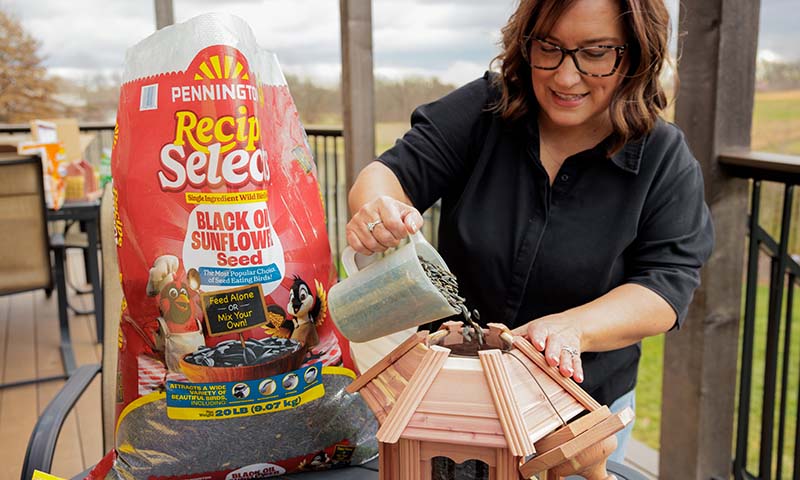
Grosbeaks are frequent feeder visitors, especially when high-energy seeds are readily available.
Other options worth adding:
- Sunflower hearts and chips (no shells, no mess)
- Safflower
- Peanut hearts
- Mealworms during nesting season, when protein matters most
- Fresh berries when in season
Pairing a quality seed blend like Pennington Feeding Frenzy All Birds High Variety Blend with with a suet cake like Pennington Feeding Frenzy Orange Delight No Melt Suet Dough helps provide grosbeaks with a wider range of food sources, attracting more species, and supporting backyard activity throughout changing seasons.
Where the Name Comes From
Here's a quirk most birders enjoy: "grosbeak" isn't a family. It's a description.
The word comes from the French gros, meaning thick or large. Early naturalists used it as a kind of nickname for any songbird with a hefty, seed-cracking beak. They weren't sorting by family tree — they were sorting by tool. So the label ended up stuck on cardinals, finches, tanagers, and even certain weaverbirds half a world away in Africa. None of them are close relatives. They just happen to carry the same kind of bill for the same kind of job.
Modern science groups birds by genetics now, not appearance. But the old name held on, and most birders find it more charming than confusing.
Spotting a Grosbeak
Three features give a grosbeak away:
- The bill. Short, thick, and cone-shaped — built for cracking.
- The body. Solid and a little front-heavy compared to most songbirds.
- The color. Males often show off rich reds, blues, oranges, or yellows. Females lean toward browns and grays with soft streaking.
When the look is hard to read, the song helps. Grosbeaks sing in clear, whistled phrases that travel well through the trees.
Behavior gives clues, too. Pay attention during nesting season. A male may sing from a high, exposed perch, and in some species he'll stay close to his mate while she forages — shadowing her movements, chasing off rivals, and sounding off if anything gets too near. Birders call this mate-guarding, and it shows up across several grosbeak species.
Five Grosbeaks Worth Knowing
| Species | Family | Male Field Marks | Where to Look |
| Blue Grosbeak | Cardinal | Deep blue overall with rusty wing bars |
Across the southern U.S. into Mexico |
| Rose-breasted Grosbeak | Cardinal | Black-and-white body with a crimson chest patch | Eastern and central North America in summer |
| Black-headed Grosbeak | Cardinal | Burnt-orange body, dark hood, bold black-and-white wings | Western U.S. into Mexico |
| Pine Grosbeak | Finch | Soft rosy red overall with gray accents | Northern conifer forests |
| Evening Grosbeak | Finch | Gold body, dark head with yellow brow, pale greenish bill | Northern and western forests |
A note on size: most finches are tiny, palm-sized birds. The Pine Grosbeak isn't one of them. It's about the length of an American Robin, with a thicker chest and a heavier bill — a much chunkier silhouette than the goldfinches and house finches sharing the same feeders, and one of the easiest finches to pick out in winter.
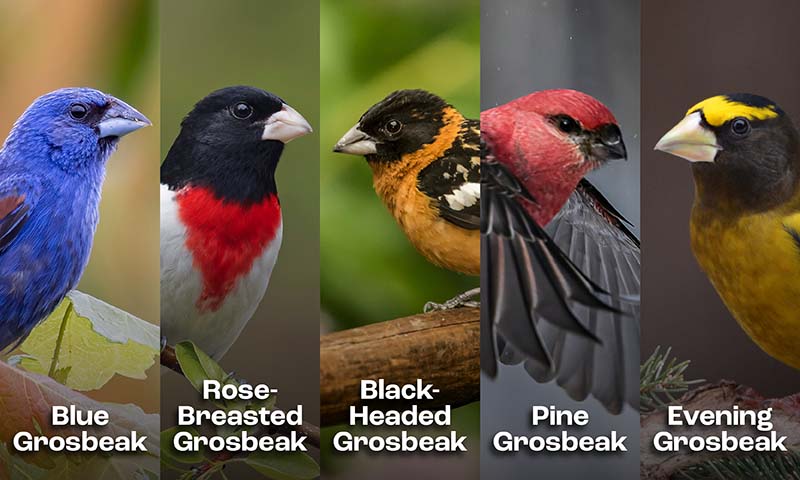
Different grosbeaks visit at different times of the year. Knowing when they're nearby can help you attract more birds.
Grosbeaks Through the Seasons
Different grosbeaks move in very different ways. Instead of thinking about "migration" as one thing, picture what's happening in your part of the country at any given time of year.
Up north, year-round. Pine Grosbeaks mostly stay in the boreal spruce and fir belt. In hard winters, small flocks sometimes drift south on what birders call irruptions — surprise visits that can turn an ordinary January feeder into the highlight of the season.
Out west. Black-headed Grosbeaks fill in as the summer regular, then make a relatively short trip down to central Mexico for winter. Evening Grosbeaks roam through mountain conifers and may pop up at lower elevations without much warning.
In the East and Midwest. Rose-breasted Grosbeaks arrive in spring and nest from the Midwest up through New England and into Canada. By fall they're long gone, headed for Central or South America. Across the warmer southern states, Blue Grosbeaks take over the summer slot.
The lesson: keep a calendar in mind. Knowing when a species moves through your area helps you put the right food out at the right moment.
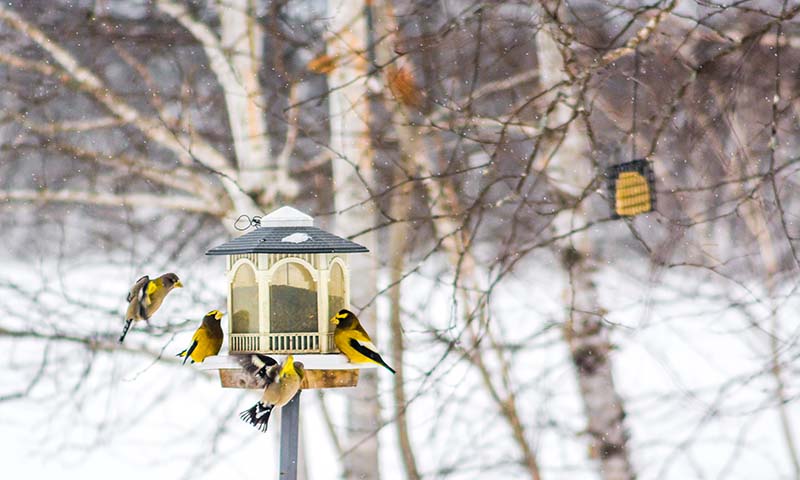
Some grosbeaks stay in northern forests year-round, while others migrate or irrupt south in search of food.
Common Mistakes to Avoid
A few small slip-ups can keep grosbeaks away from a yard that should otherwise work:
- Cheap filler seed. Mixes loaded with milo or wheat get kicked to the ground, not eaten. Stick with quality seed.
- Tubes only. Stocky birds don't fit on slim perches. Add a hopper or a tray.
- Feeders out in the open. No nearby cover, no grosbeaks. Move closer to trees and shrubs.
- A dirty feeder. Mold and old shells push birds away and can make them sick.
- Quitting too early. Grosbeaks come and go with the seasons. A quiet feeder in February may be packed in May.
For more tips on choosing feeders, seed, and setting up a bird-friendly backyard, explore our guide to getting started with wild bird feeding.
With the right seed, feeder, and nearby cover, grosbeaks can become exciting backyard visitors throughout the year. Keep feeders stocked, stay patient, and watch seasonal movement patterns — a colorful grosbeak may show up when you least expect it.
Always read product labels and follow instructions carefully.


